1000 red beats
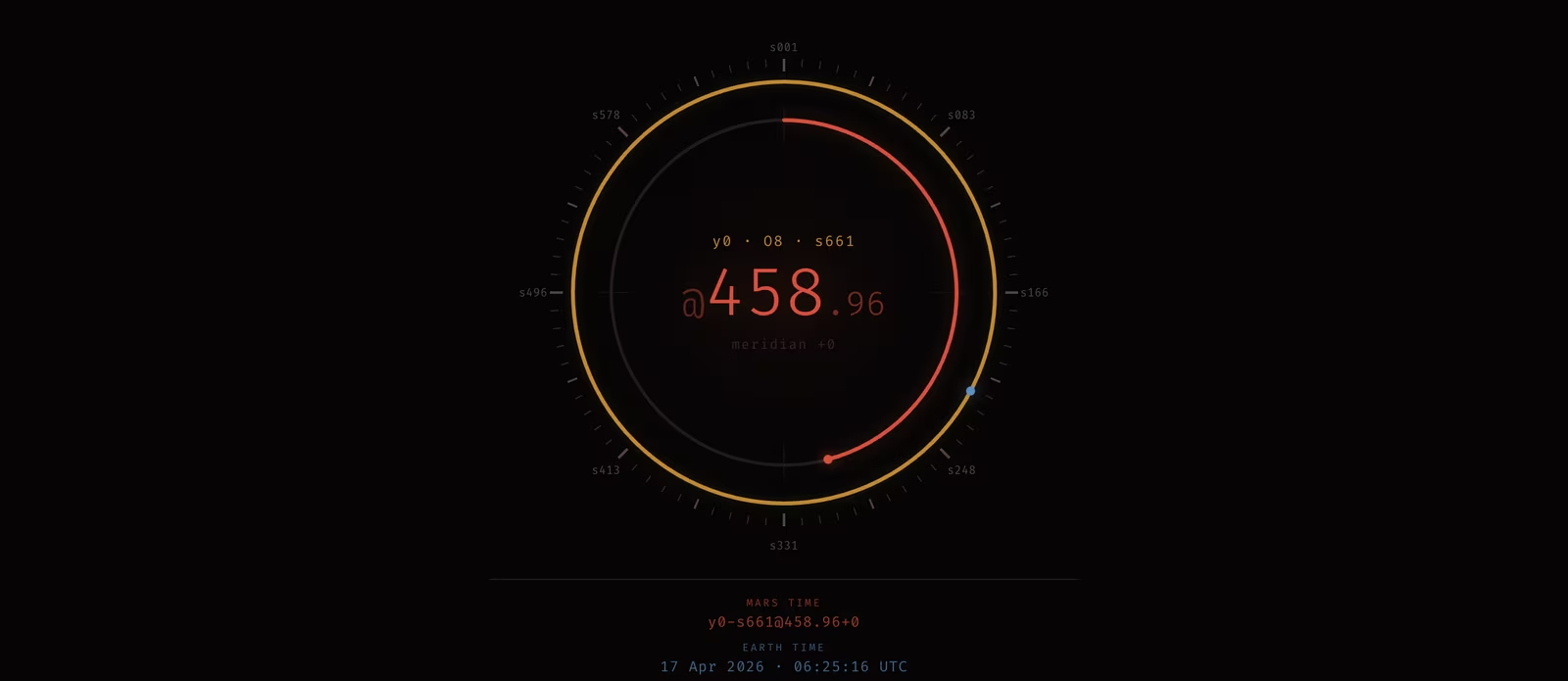
it's long overdue to talk about time in a blog called zeitraum (german: time + space).
lately, a shift has been crystallizing in my work. code writes itself now, architecture decisions that used to take days have to be made in minutes: in my perception, the focus and the demands on everyone are shifting away from building and writing, toward designing and conceptualizing. the new art is designing systems — rules, structures, orders within which AI then builds.
and once you start thinking in and about systems, you notice: there are many invisible systems we don't even perceive, because they're so old that we mistake them for laws of nature. and since it's long overdue to talk about time in a blog called zeitraum — time will be the subject of this article.
24 hours. 60 minutes. 7 days. all design decisions. babylon. mesopotamia. rome. the word "minute" comes from pars minuta prima — the first small part. "second" from pars minuta secunda — the second small part. latin words for fractions of an hour that is itself babylonian.
design decisions that feel so natural to us that they have stubbornly resisted the elegance of metric systems.
swatch internet time and the psychology of humans
in 1998, swatch tried anyway. 1000 beats per day, no time zones, the prime meridian at their headquarters in biel, switzerland [1]. the .beat — a marketing gag. but a clever one.
i like swatch beats: they're clean, decimal, systemically consistent. but the psychologist in me immediately knew why this system couldn't work.
the first reason is biology. our internal clock doesn't run on an abstract number but on the solar day. it matters to humans that midnight feels like midnight — dark, quiet, the day is over. with swatch beats, @000 was midnight only in biel. in tokyo, @000 was morning. the system ignored that time for humans isn't an abstract coordinate system but a bodily experience — and neither the internet nor globalization has changed that.
the second reason is culture. the base-60 system of our timekeeping comes from babylon, around 2000 BCE [2]. when something is as old as writing and civilization itself, it's not simply a convention — it shapes the thinking of entire societies. you don't swap that out because a more elegant alternative exists.
though that is, as so often, a eurocentric perspective: the chinese had divided the day into 100 ke (刻) during the han dynasty around 200 BCE. 14 minutes and 24 seconds per unit [3]. "ke" literally means "marking" or "engraving," referring to the marks on sundials or water clocks used to measure time. a decimal time system that lasted over a thousand years, until jesuit missionaries brought mechanical clocks in the 17th century. a decabeat, 2200 years before swatch.
why time resists
the deeper reason time never went metric, though, is neither biology nor culture. it's astronomy.
the three great cycles — earth's rotation, earth's orbit, lunar phase — share no integer relationship. a solar year has 365.24 days. a lunar month has 29.53 days. 12 lunar months add up to 354 days — 11 short of a year. babylonians, romans, chinese — all tried to reconcile these cycles. none succeeded cleanly, because the ratios don't reduce to neat fractions. that makes timekeeping a remarkably hard system design problem.
four thousand years of the babylonian hour, any new system would also have contradictions, and the switching costs would be absurd. some things have value because they've grown historically. the swatch beats never stood a chance. not everything needs to be disrupted. even if you enjoy disrupting things.
but what about mars?
"ha!" comes the reply to the reality-bound enemy of disruption: that only applies to earth.
the martian day lasts 24 earth-hours, 39 earth-minutes, and 35 earth-seconds [4]. on mars there's no babylonian tradition, no cultural embedding, no base-60 minutes. for the disruptive system designer, a dream — a greenredfield project.
the obvious solution: just take 24 hours and stretch everything a little. mars-hours, mars-minutes. familiar, simple, intuitive. JPL does exactly this — earth units, stretched by a factor of 1.02749 [5].
it sounds reasonable, but i genuinely think it's dangerous.
when similarity kills
a mars-minute would be 61.65 earth-seconds. a mars-hour would be 61.65 earth-minutes. NASA stretches all units uniformly by a factor of 1.02749 — hours, minutes, seconds, everything 2.75% slower than on earth [6]. during the spirit and opportunity rover missions, many JPL team members wore wristwatches whose quartz crystals had been physically modified to tick at the martian rate. each day their work schedule shifted roughly 40 minutes relative to earth time [6].
close enough to earth units to confuse. different enough to produce errors. someone reading "42 minutes" won't instinctively check whether it's mars-minutes or earth-minutes — because the number looks plausible.
that sounds hypothetical. it isn't. in 1999 the mars climate orbiter was lost — burned up in the martian atmosphere because one team calculated in pound-seconds while another expected newton-seconds [7]. 125 million dollars, gone, because the numerical values were in the same order of magnitude and nobody noticed the error. everything looked approximately right.
as a passionate maker of careless mistakes, i know this principle very well: the most dangerous confusions are the ones that look plausible. if something is obviously wrong, it gets caught. if it's almost right, it slips through. this applies to thought patterns just as much as to engineering systems.
the lesson for system design is clear: when two units look similar but differ, humans will confuse them. not maybe. guaranteed. and the solution isn't better labeling or more warnings. the solution is making the confusion structurally impossible.
a well-designed system prevents errors through its form, not through its documentation (which nobody really reads anyway).
the right idea in the wrong place
maybe beats were the right idea in the wrong place — or more precisely, on the wrong planet.
1 sol = 1000 beats. @000 is midnight, @500 is solar noon. one beat lasts 88.78 earth-seconds — roughly a minute and a half. it doesn't look like a minute, doesn't sound like a minute, and won't be confused with a minute. @417 is obviously a different system than 10:03 AM.
the system break isn't a drawback here — it's the feature. every communication between earth and mars requires a conversion anyway. but then 1 sol = 1000 beats is a clean decimal conversion, instead of the awkward fraction of 24 hours, 39 minutes, and 35 seconds.
it would essentially revive the ke system of the han dynasty. 10 beats, a decabeat, correspond almost exactly to one ke (刻) [3]. a unit that proved itself in actual human life over millennia.
on earth, beats are an aesthetic marketing gag. on mars, they're the safer engineering decision.
the body on mars
the question remains: can humans even live on a 24-hour-39-minute day?
in university i learned that our internal clock doesn't run at exactly 24 hours. the actual value is 24 hours and 11 minutes [8] — the older textbooks claiming 25 hours were wrong; it was a measurement artifact. so our clock is 11 minutes too slow on earth, which everyone feels in the morning when the alarm goes off and the body says: just a bit more.
on mars it would be reversed. the internal clock would be 26 minutes too fast: you'd get tired too early in the evening and have to keep yourself awake for another half hour. reverse jetlag, every day. the good news: studies show that humans can be entrained to a sol rhythm, at least when the light environment is right [9]. chronobiologically speaking, humans sit almost exactly between earth and mars. a beautiful coincidence.
during the rover missions, JPL teams tried living on mars time while on earth. after three weeks: "permanent jetlag" — most teams gave up [10]. but that was mars rhythm fighting against earth sunlight, combined with social desynchronization from their surroundings — a double stressor. on mars itself, the ambient light would support the sol rather than sabotage it, and team members would all live on the same rhythm.
martian evenings would be the difficult time of day. where mornings are tough on earth, on mars evenings would be an exercise in patience. i wonder what that would mean culturally. a civilization that's energetic in the morning and meditative in the evening?
a system that follows nature
the martian year lasts 668 sols — nearly twice as long as an earth year — and because the martian orbit is significantly more elliptical than earth's, its seasons are extremely unequal: northern summer lasts 178 sols, northern winter only 154 [4].
on earth we have months that follow no astronomical correlate. january is an arbitrary boundary, an artifact of the julian calendar reform. on mars you could do better: divide the year not into equally long time periods, but into equally large orbital segments. 16 phases of 22.5 degrees areocentric solar longitude each — astronomically exact and never shifting [5]. each phase contains 35 to 50 sols, depending on where mars is in its orbit.
a system that follows nature instead of working against it. one that doesn't pretend all months are the same length when physics says they aren't.
there's one sci-fi idea i still need to fit in: earth day. roughly every 780 earth-days, earth and mars are in opposition — minimal distance, shortest signal delay, about 3 minutes instead of up to 22 [4]. not every mars-year has such a day. that makes it special and an obvious martian holiday: the day when a conversation with home is least painful and you're closest again to the origin of humanity.
systems shape thinking
we've been measuring time for millennia, and most of us never think about it. 17:37. wednesday. april. all so familiar it's become invisible. but every piece of it is a design decision, and every design decision shapes how we think, plan, and make mistakes.
whether anyone will actually use beats on mars, i don't know. the first mars colony will probably start pragmatically, with earth time and a shared google calendar. but the question what would a good system look like is never wasted, whether you're designing a time system, an API, or an organizational model.
a good system is obviously different when it is different. it follows nature instead of bending it. it prevents errors through its form, not through warnings, and it respects that humans are not machines.
for four thousand years, nobody questioned the babylonian hour. mars will ask the question every sol.
ps: if you want to live on red beats already — i've published the mars clock, the widgets, and the algorithm on github. try it at 1000beats.red.
translated from the german original by claude opus 4.7.
how did you like this post?